


Foreword: This is a non‑partisan, informational analysis intended to examine facts with rigor. Any perceived opinions are the authors’ alone; not those of any past, current, or future employers. Review the references, think critically, and draw your own conclusions. Our aim is reflection, not prescription; even when the truth is uncomfortable.
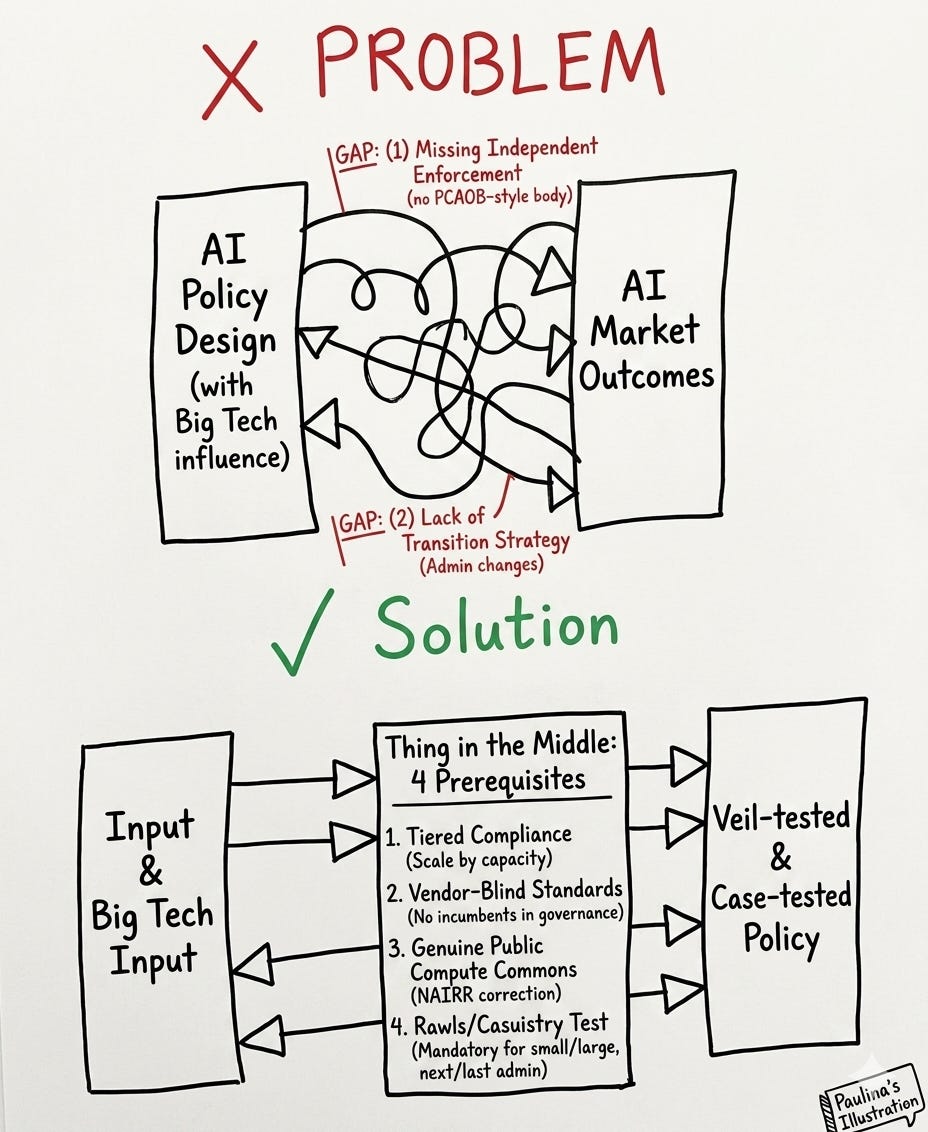
The rules governing artificial intelligence in the United States are being written by the entities with the most to gain from their specific design. That condition does not require bad actors. It requires only a process without structural safeguards, and that is precisely what we have.
This essay applies two methodological frameworks to that diagnosis: Rawls’ veil of ignorance as an operational gate on policy design, and the Jesuit method of casuistry as the discipline for testing whether proposed solutions survive contact with the specific cases they claim to address. The conclusion is not that we need better policy. It is that we need the structural prerequisites without which any policy reproduces the problem it claims to solve.
Two Frameworks
The veil of ignorance and the descent into particulars are not rhetorical choices. They are the specific methodological tools required to catch what neutral language conceals, and they are chosen here because they do different work that is both necessary.
Rawls proposed that fair principles should be selected from behind a veil of ignorance: a hypothetical position in which the chooser does not know what role they will occupy in the resulting society. We propose something more demanding than a thought experiment. Install the veil as an operational mechanism in the procurement design process. Before any federal AI procurement framework advances to legislation, it must answer two questions. Does this framework produce the same competitive outcomes if a small vendor and a large incumbent exchange positions? Does it produce the same competitive outcomes if the current administration and an opposing administration exchange positions? If the answer to either is no, the framework requires structural revision before it moves forward. This is not a soft standard. It is a hard gate. The Biden compliance framework fails it. The Trump AI Action Plan fails it. The sequencing matters: applying this test after a framework is adopted inherits whatever asymmetries the design process produced. The test must be applied before, as a condition of advancement.
The Jesuit method of casuistry adds the discipline the veil alone cannot provide. Where the veil removes self-interest from the design process, casuistry tests whether the resulting design actually holds when it meets the ground. It does this by comparing new dilemmas to familiar cases using what is already known while adapting judgment to what is different. A policy that passes the veil test but fails case scrutiny offers fairness in theory without substance in operation. A policy grounded only in case analysis, without the veil, risks becoming a system shaped by those with the greatest access to power and design.
Applied together to AI policy: casuistry demands close attention to how broad commitments (competition, safety, public benefit) function in specific cases. The veil then asks whether the response to those cases would still seem just if no one knew which position they would occupy. These are not sequential steps. They are a continuous check on each other, and both are necessary because the failure mode in AI governance is incremental, institutional, and largely invisible until the consequences are undeniable.
What the Prior Analysis Establishes, and Where It Stops
The series preceding this essay established four things with genuine rigor: that process capture is a structural inevitability when the regulated participate in designing their regulations; that this pattern repeats across highly regulated industries including telecommunications, pharmaceuticals, financial services, and aviation; that incremental adjustment within a captured design inherits the capture; and that both the Biden and Trump frameworks, despite opposite vocabularies, produce functionally identical asymmetries. Two gaps remain:
The first is enforcement. Structural reforms stated as design requirements are not self-executing. Without enforcement architecture, structural reforms drift back toward the interests of the entities with the most sustained presence in the governance process. That drift is not hypothetical. It is documented. We will address it in the interventions below. The model for the correction already exists. The PCAOB, created by SOX to provide independent oversight of the auditing industry, has been a more durable structural reform than the compliance requirements themselves, precisely because it created an institution with an ongoing mandate and independence from the industry it oversees. The AI equivalents of the PCAOB require the same institutional design: statutory independence, confirmed leadership, transparent operations, and funding structures that do not create commercial dependencies on the entities being governed. Naming the institutional model is not optional. A structural prerequisite without an enforcement institution to maintain it is an aspiration with a sunset built in.
The second is transition. The entities most invested in the current configuration do not pause while structural reform is being designed. They continue to write standards, shape procurement, and accumulate market share. A strategy for the transition period is the difference between structural reform that takes effect and structural reform that remains permanently aspirational. A framework that survives only as long as its authors remain in power is not governance. It is a temporary imposition of one set of preferences over another.
These two gaps point toward four structural prerequisites that must be built before any comprehensive AI policy framework is layered on top of them. Each one addresses the same underlying condition that rules written inside a captured process will serve the entities with the most access to its design and each one must be in place before the next layer is added, because adding policy on top of an uncorrected structural condition does not fix the condition. It inherits it.
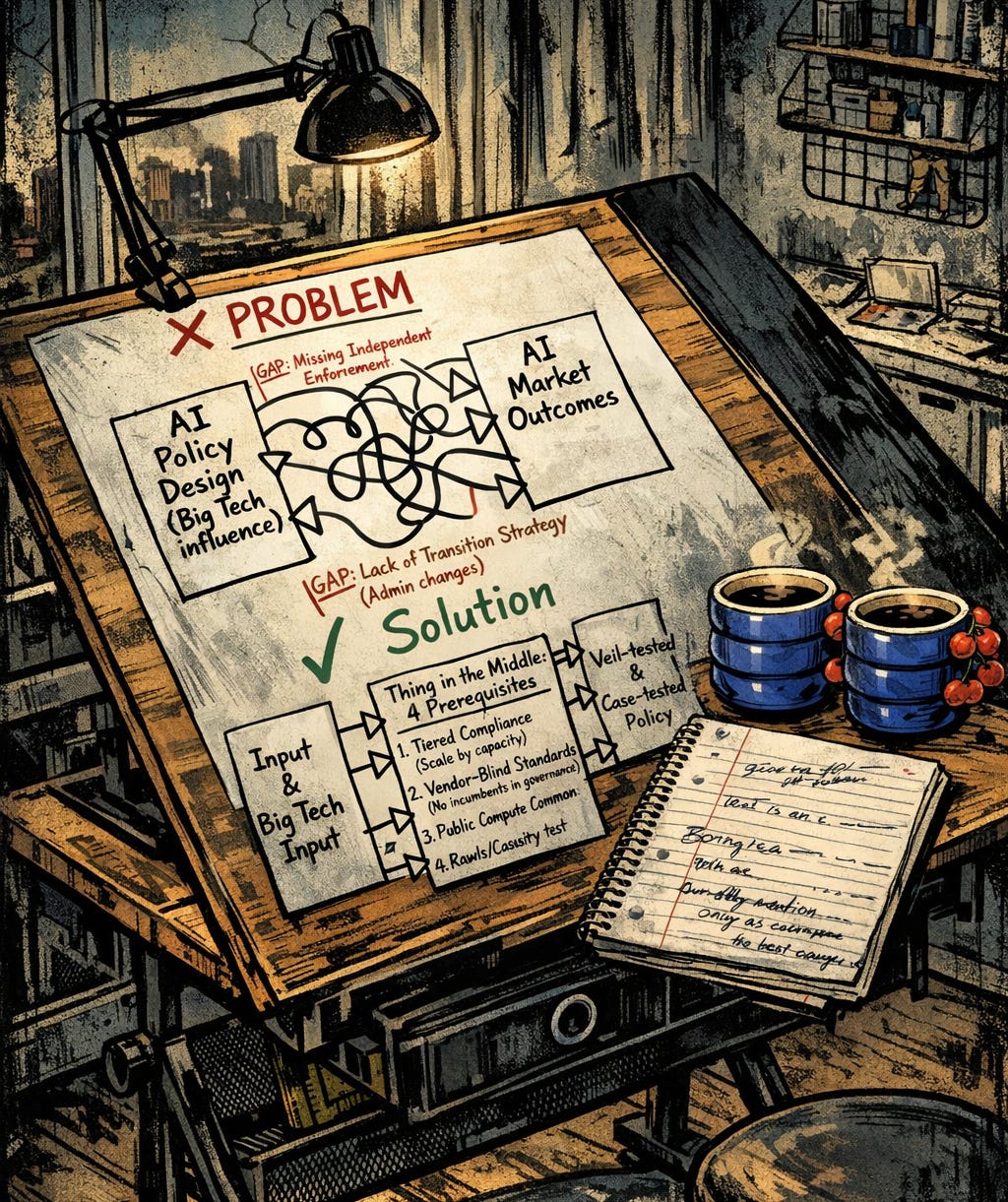
Four Structural Prerequisites
One: Tiered Compliance Architecture- The institutional design error shared by both the Biden and Trump frameworks is the calibration of compliance requirements to the risk profile of the technology rather than to the economic capacity of the vendor deploying it. These are two different variables. Conflating them produces a regulatory environment that functions as a market filter rather than a safety mechanism.
The SOX case establishes the paradigm, and it is worth examining precisely because it succeeded on its own terms while producing the failure this analysis identifies. The Sarbanes-Oxley Act of 2002 was passed in direct response to the Enron and WorldCom accounting scandals. Section 302 required CEO and CFO personal certification of financial report accuracy. Section 404 mandated independent auditor assessment of internal controls. The Public Company Accounting Oversight Board was created to oversee auditors in a way the previously self-regulated accounting industry had conspicuously failed to oversee itself. Measured against the specific failures it was designed to address, SOX worked.
The asymmetry problem emerged not in the design of the legislation but in its implementation economics. Large public companies had existing compliance infrastructure that could absorb the SOX burden with friction but without existential strain. Smaller public companies faced a materially different calculation. The SEC’s own staff estimated Section 404 compliance costs between two and four million dollars annually for companies below a certain revenue threshold, a cost that for a mid-size company could represent a significant percentage of operating income. IPO filings declined. A significant portion of companies that chose not to go public cited compliance costs as the factor.
The EU AI Act is repeating this pattern in a different jurisdiction: four hundred thousand to two million euros annually per company, with approximately forty percent of European AI small and medium enterprises finding compliance costs insurmountable. The mechanism and the outcome are identical. The policy community is watching it happen in real time and producing the same response it produced after SOX: acknowledgment that compliance costs are burdensome, followed by incremental adjustments that do not address the structural condition producing the burden.
The regulation does not need to be hostile to function as a market filter. It only needs to be expensive. We are waiting on the political will to apply an existing instrument to a domain where it does not yet operate.
Applied to AI procurement, the requirement is direct: compliance obligations for a vendor under fifty million dollars in annual revenue pursuing a contract under five million dollars must be proportionate to that scale, not to the scale of a Fortune 500 legal department. The veil test makes the asymmetry visible immediately. If the designers of these compliance frameworks did not know whether they would be a small vendor or a large incumbent when the rules took effect, they would not have designed them this way.
Two: Vendor-Blind Standards Governance- The Federal Aviation Administration does not invite Boeing to write certification standards for Boeing aircraft. This principle, obvious when stated plainly, collapsed in practice under the Organization Designation Authorization program, through which the FAA delegated certification authority to engineers employed by the manufacturers whose aircraft they were certifying. The FAA retained nominal oversight while transferring operational responsibility to the industry being regulated.
The Boeing 737 MAX crashes of 2018 and 2019 are the outcome of that arrangement made catastrophic. The flight control software implicated in both crashes was not disclosed as requiring specific pilot training. The delegated certification process did not catch the omission. Three hundred and forty-six people died. The post-crash finding that matters for this analysis is not about negligence. The Boeing engineers had technical expertise. The problem was that technical expertise and financial interest arrived together from the same entity and could not be cleanly separated. Financial interest structures technical judgment not through deliberate falsification, but through institutional loyalty, career incentive, and the human tendency to find what one is looking for.
The distinction the ODA program eroded is precisely the one now eroding in AI governance. The FAA did not invite Boeing to write Boeing’s standards. It delegated to Boeing the authority to certify Boeing’s compliance with those standards. OpenAI and its peers currently sit in the room where AI safety and interoperability standards are written. Technical expertise and institutional preference cannot be cleanly separated when they arrive together from the same entity with the same financial stake in the outcome. That is not an allegation of bad faith. It is a description of a structural condition that produces predictable outcomes regardless of the intentions of the individuals inside it.
The correction that followed the MAX crashes was structural, not motivational. Congress required FAA engineers to have lines of communication independent of Boeing, and that ODA unit members not face undue commercial pressure in their certification decisions. The reform did not ask Boeing to behave better. It removed Boeing from the governance seat and left it in the advisory role. The same correction applies here. Solicit technical expertise from commercial AI incumbents through public comment, subject to the same transparent process available to any party. Remove them from the governance seat entirely. The presence of financial interest in the governance structure is a conflict of interest. It must be named as one before we can design around it. Casuistry makes the parallel unavoidable: we have already seen what this structure produces in aviation. We are not guessing at the outcome in AI.
Three: A Genuinely Public Compute Commons- The National AI Research Resource, launched in January 2024, is formally positioned as a public resource for AI research access. Its actual structure includes twenty-eight private sector partners with financial stakes in the infrastructure being administered. The NAIRR is not a genuinely public compute commons. It is the AI policy equivalent of the FAA’s delegated certification authority: formally independent, structurally dependent. And like the ODA program, it functions as rhetorical cover for the absence of the genuinely independent infrastructure this analysis calls for.
That gap must be named explicitly in every policy conversation that cites the NAIRR as evidence of existing public compute access. The gap is the argument.
The compute costs that constrain independent builders are not incidental to their competitive position. They are their competitive position. The large incumbent’s structural advantage in AI is not primarily talent or ideas. It is access to compute at a scale and cost that a bootstrapped operation cannot match. Academic researchers who depend on compute access for genuinely independent AI science share a structural interest in fixing this, and their institutional presence in AI policy conversations is smaller than their epistemic contribution to those conversations. Connecting that constituency to the legislative process is part of building the prerequisite, not a follow-on task.
The transition period requires three instruments that do not depend on the prerequisites being in place. First, existing antitrust and competition authority must be applied actively to AI markets during the interim. The Sherman Act, the Clayton Act, and FTC competition authority are available instruments. Using them does not require the structural prerequisites to exist first. Second, comprehensive AI policy frameworks adopted before the prerequisites exist should include explicit sunset provisions requiring reauthorization under a process that meets the procurement test. This converts the transition from an indefinite status quo into a defined interval with an endpoint. Third, every policy conversation that cites the NAIRR as evidence of existing public compute infrastructure must name the gap between its formal mandate and its actual structure with twenty-eight private sector partners. The gap is the argument. Making it visible prevents the NAIRR from functioning as rhetorical cover for the absence of the genuinely independent infrastructure this analysis calls for.
Federal investment in shared university research infrastructure across the twentieth century created conditions under which scientists without access to well-endowed private institutions could compete on the quality of their work. That investment produced the scientific base from which American technological dominance was built. The question is not whether we know how to build shared public infrastructure. We do. The question is whether the collective will exists to build it without handing its administration to the incumbents who would prefer to administer it on behalf of the public they would simultaneously compete against.
The veil test catches this immediately. If the designers of the NAIRR did not know whether they would be a private sector partner or an independent researcher when the governance structure was finalized, they would not have designed it with twenty-eight commercial partners holding financial stakes in its administration.
Four: The Rawls/Casuistry Procurement Test as Formal Procedure- The first three prerequisites address specific structural conditions. This one addresses the process that produces all of them. It must be installed as a formal procedural requirement not a recommendation, not a guideline, but a condition of advancement before any AI procurement framework moves to legislation.
Casuistry requires that we demonstrate the asymmetry at the level of the specific case rather than assert it at the level of the general claim. The Biden administration’s AI governance framework, operationalized through the October 2023 Executive Order, established compliance requirements calibrated to the risk profile of AI systems. Meaningful participation in federal AI procurement under that framework required the capacity to perform and document red-team evaluations, produce detailed technical documentation of model architecture and training data, navigate the NIST AI Risk Management Framework, and maintain ongoing reporting relationships with multiple federal agencies. These requirements are not unreasonable for a company with a dedicated AI governance team. They are effectively prohibitive for a vendor without those resources, regardless of the quality of the AI product being offered.
The Trump administration’s AI Action Plan uses language that is ideologically opposite. It explicitly rejects burdensome regulation and emphasizes American AI dominance. It produces a structurally similar outcome through a different mechanism. A procurement environment that prioritizes speed of deployment and alignment with administration priorities creates its own access barriers: government relations infrastructure capable of navigating an informal, relationship-dependent procurement culture. The company that can afford a Washington office staffed to cultivate procurement relationships has a structural advantage that is functionally equivalent to the compliance infrastructure advantage conferred by the Biden framework.
This is the casuistic finding. Both frameworks, examined at the level of specific vendor capacity rather than abstract policy intention, close the market to companies that did not participate in their design. The vocabulary is opposite. The structural outcome is identical. The veil test formalizes that finding as a condition of advancement: if the architects of either framework did not know whether they would be a large incumbent or a bootstrapped startup when the rules took effect, they would not have designed them this way.
The test has two gates. The structural gate asks whether the framework produces the same competitive outcomes regardless of which position in the market the evaluator occupies. The durability gate asks whether the framework produces the same outcomes regardless of which administration is applying it. Both gates must be cleared. A framework that passes one and fails the other is not fair; it is selective, which is another name for designed asymmetry.
Casuistry supplies the case discipline the veil alone cannot provide. The veil removes self-interest from the design process. Casuistry then asks: does this design actually hold when it meets the specific cases it claims to govern? The Biden framework looked neutral on safety and systematically disadvantaged vendors without compliance infrastructure. The Trump framework looks neutral on ideology and will systematically disadvantage vendors without government relations infrastructure. A casuistic analysis of either framework, beginning with the specific vendor trying to compete for a federal contract, reveals the asymmetry the neutral language conceals. The veil test formalizes that revelation as a condition of advancement rather than an after-the-fact critique.
Together, the two frameworks catch the failure mode before it is institutionalized. That is the only stage at which it can be corrected without legislative reconstruction after the damage is done.
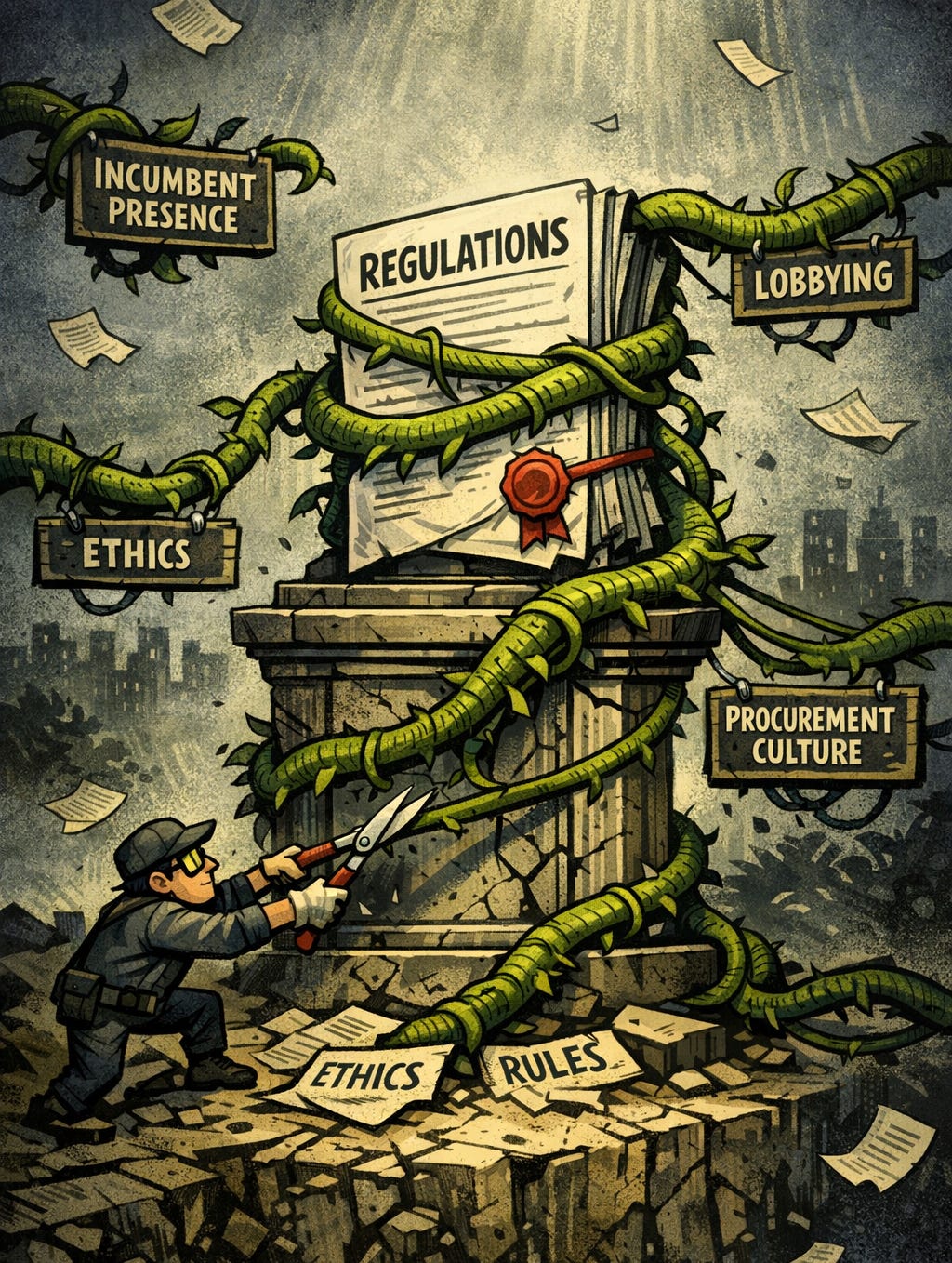
The Work That Makes the Policy Document Honest
These four prerequisites must be sequenced before the framework, enforced through institutions designed to resist drift, and defended through the transition period with existing statutory tools. They must also be built by constituencies that do not yet have the organizational voice to demand them: small vendors, independent researchers, academic institutions whose epistemic contribution to AI policy exceeds their political presence in the rooms where that policy is written. Building that organizational voice is not a separate task. It is part of building the prerequisite.
The thesis of this analysis is not complicated. The rules governing AI are currently being written by the entities with the most to gain from their specific design. Every intervention above addresses that single condition from a different angle. Tiered compliance architecture removes the market filter that functions as incumbent protection wearing safety’s language. Vendor-blind standards governance removes the conflict of interest that the MAX crashes proved cannot be managed through individual integrity alone. A genuinely public compute commons removes the infrastructure dependence that makes nominal independence structurally fictitious. The procurement test removes self-interest from the design process before the design is complete rather than critiquing it afterward.
A commitment to broad AI access means nothing without public compute infrastructure genuinely accessible to independent builders. A commitment to AI safety means nothing without a standards-setting process genuinely independent of the companies whose products are being standardized. A commitment to democratic accountability means nothing without procurement frameworks that remain fair when administrations change.
Design the rules from behind the veil. Test them against the specific cases they claim to govern. Build the infrastructure as a genuine public good. Keep the governed off the governing body. Scale the costs to the capacity bearing them. These four commitments are not a comprehensive AI policy. They are the structural prerequisites without which any comprehensive AI policy produces outcomes that serve the entities with the most access to its design.
The market does not fail from bad AI. It fails when the rules governing AI are written by the companies that benefit from those rules. The republic does not fracture from bad code. It fractures when code becomes partisan scripture. We are watching both failures develop simultaneously.
If Big Tech is serious about broad-based prosperity: bring checkbooks. Fund the infrastructure. Support the structural prerequisites that would subject your products to genuinely independent standards review. Accept the governance seat prohibition as the cost of operating in a market whose legitimacy depends on your not controlling its rules.
Thank you for spending time with this piece. This essay grew out of a long arc of conversations, shared questions, and the kind of back‑and‑forth that forces clarity. It was a true collaboration. And a special thanks to PAULINA PÉREZ , whose discipline, curiosity, and insistence on structural honesty shaped the spine of this piece. You can find more of his work at Prettysurenooneasked
Like this piece?
If this piece holds, consider sustaining the signal: subscribe, pledge, buy me a cup of coffee, or fund the next dispatch however you see fit. Every act of support helps metabolize the noise and keep the infrastructure unfinished but alive. Repost if it threads utility. Share if it exposes contradiction. Let it circulate where it’s needed most.
Sources and Further Reading
Rawls, John. A Theory of Justice. Harvard University Press, 1971.
Casuistry and Probabilism. KU Leuven, Christian Ethics History Series. https://theo.kuleuven.be/apps/christian-ethics/history/casuistry.html
Using the Veil of Ignorance to align AI systems with principles of justice. PMC/NIH, 2023. https://pmc.ncbi.nlm.nih.gov/articles/PMC10160973/
Woodruff, David M. Towards a Just and Fair Internet: Applying Rawls’ Principles of Justice to Internet Regulation. Ethics and Information Technology, Springer, 2015.
Congressional Research Service. FAA Reauthorization: Aviation Safety Oversight. CRS Report R46904.
SMU Journal of Air Law and Commerce: FAA Certification and Delegated Authority. https://scholar.smu.edu/cgi/viewcontent.cgi?article=4163&context=jalc
H.R.3763: Sarbanes-Oxley Act of 2002. https://www.congress.gov/bill/107th-congress/house-bill/376
Cornell Law School: Sarbanes-Oxley Act Overview. https://www.law.cornell.edu/wex/sarbanes-oxley_act
National Science Foundation: NAIRR Pilot Program. https://www.nsf.gov/focus-areas/ai/nairr
S.3971: SBIR/STTR Reauthorization Act, 119th Congress (April 2026). https://www.congress.gov/bill/119th-congress/senate-bill/3971
Stigler, George. “The Theory of Economic Regulation.” Bell Journal of Economics and Management Science, 1971.
Stress Test: How the White House AI Action Plan Fails the Republic. https://againstr.substack.com/p/stress-test-how-the-white-house-ai
Gilens, Martin, and Benjamin Page. Testing Theories of American Politics: Elites, Interest Groups, and Average Citizens. Perspectives on Politics, 2014.
Schumpeter, Joseph. Capitalism, Socialism and Democracy. Harper and Brothers, 1942.
 | A guest post by
|
This is strongest when it stops being about “AI policy” and becomes about process legitimacy.
What the piece actually isolates is not a set of technical reforms, but a recursive failure mode: when regulatory design is performed inside the same incentive field it is meant to constrain. The Rawls/veil framing and casuistic testing work best here as diagnostic tools rather than philosophical decoration — because they expose something simpler underneath: asymmetry is not an error in these systems, it is their default equilibrium.
The most important move is the insistence on pre-legislative gating. That shifts the conversation from “better rules” to “conditions under which rules are allowed to exist at all.” And that’s where the argument becomes structurally serious, because it is no longer assuming neutrality can be restored after capture — it is trying to prevent capture from becoming encoded in the first place.
In that sense, the essay is less about AI governance than about whether governance can still be meaningfully separated from the systems it governs.