
Perfect Days: The Serendipitously Ideal Date
Part 3: The Serendipity Walk, the Waldorf Astoria, and the moment when the cinematic frame dissolves

A Note Before We Begin: This is the third and last installment of Perfect Days: A Cinematic Pilgrim’s Guide to the Cities We Love. The series is part travelogue, part cultural analysis, part confession. If you’ve been reading along, we began in London, made a detour through Chicago, and stayed in New York for the rest of the series. You don’t need to have seen all the films. Just get your comfortable shoes and enjoy.
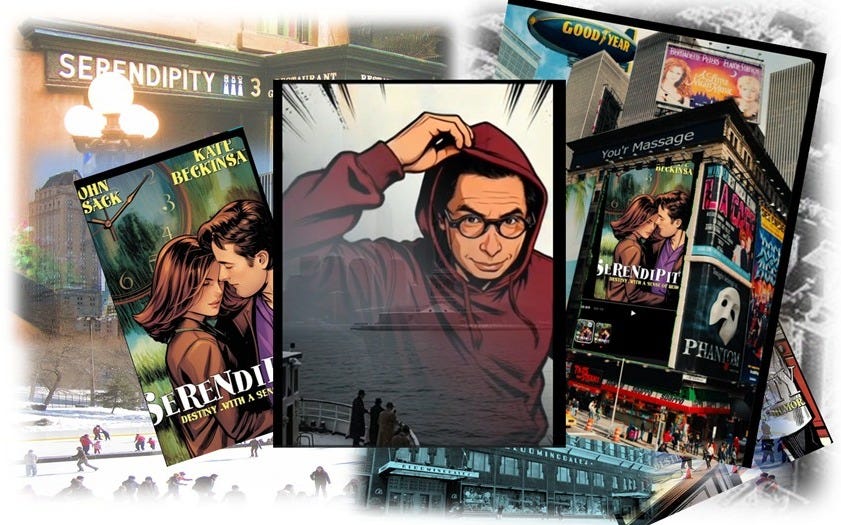
Most cinematic pilgrimages are a solo sport. Going with someone who does not share the reference points will ruin the experience for you. They will stand outside the blue door in Notting Hill and see a door while you stand there and feel the entire apparatus of your emotional history pressing against the present moment. And they will probably think, “it’s just a door.” That gap is unbridgeable, and I say this from experience.
There is, however, one exception. One walk that is not only worth doing with another person but is specifically designed for it. It only works in late fall or early winter. It requires a particular kind of planning that has to look effortless. And it demands that you bring someone for whom the movie meant something, because the entire impact of the experience depends on shared coordinates.
I have taken someone on this date. What follows is more or less how it went.
The Serendipity Walk
Fate, Frozen Hot Chocolate, and the Questions You Only Ask in the Right Places
Two days, approximately 3 to 4 hours of walking each day. Bring a scarf. Prepare for feelings you did not plan for.
Serendipity (2001) is a film about two people who meet by accident, decide the accident was meaningful, and then spend years testing whether meaning can survive real life. Jonathan Trager (John Cusack) and Sara Thomas (Kate Beckinsale) encounter each other during a Christmas shopping rush at Bloomingdale’s in New York, spend one extraordinary evening together, and then separate on the premise that fate will reunite them if they are supposed to be together. Years later, both engaged to other people, neither can stop looking.
The film is not asking whether fate exists. Instead it asks, and perhaps more importantly, whether the decision to believe in fate is itself a form of courage, or a form of avoidance. That question is worth sitting with. These locations are where it becomes impossible to avoid.
Day One begins at Bloomingdale’s, 1000 Third Avenue at 59th Street
This is where Jonathan and Sara meet over the last pair of black cashmere gloves in the store. The flagship is still prestigious, still crowded in the way only a Manhattan department store can be crowded, still the kind of place where meaningful glances happen over merchandise. I bought something small. I kept the receipt, in the spirit of the film’s logic that ordinary objects can carry extraordinary weight. If the place looks familiar beyond the glove scene, it is probably because you have good taste in films and have also watched Moscow on the Hudson, Splash, or Cloverfield. Bloomingdale’s has been a New York character almost as long as New York has been a city.
Then we walked to Serendipity 3, 225 East 60th Street
The restaurant that named the movie. This is where Sara tells John that serendipity means “a fortunate accident” and that she believes fate sends us signs, and that how we read the signs determines whether we are happy or not. The conversation feels lightweight when you watch it on screen. It feels considerably less lightweight when you are sitting across from someone in the same restaurant having a version of it yourself, wondering whether the person across from you is reading the same signs you are.
The restaurant was a New York institution long before the movie found it. It did not change its aesthetic to capitalize on the film’s success. It kept being exactly what it was, and the film came to it. That is the sustainable model: do not perform for the camera, and the camera will eventually find you. Order the frozen hot chocolate. It is overpriced and it’s exactly what you came for. And enjoy the menu design. That alone is worth the trip.
After eating, we walked to Wollman Skating Rink in Central Park
This is why early winter is the only correct timing for this date. If the rink is open, this stop is non-negotiable. This is where Jonathan and Sara skate, where he asks if she is “marrying somebody to get a green card or on parole,” where she asks about his favorite movie and he says “Cool Hand Luke” with the particular confidence of a man who has thought about this answer since adolescence. To this date I cannot see a snippet of “Cool Hand Luke” or say “what we have here is a failure to communicate” without thinking about Serendipity.
Wollman opened in 1951, named after philanthropist Kate Wollman. It has appeared in Stepmom, Home Alone 2, Love Story, and August Rush. And of course, Big Daddy. It is one of those New York locations that has earned its symbolic weight honestly, through repeated use by filmmakers who recognized that an ice rink in Central Park already contains everything cinema wants: cold air, warm light, the risk of falling, and the presence of other people doing the same precarious thing. Everyone in the park becomes your background and supporting actors when you visit the site.
If the rink is closed when you go, stand at the edge of it anyway. Look at where the ice would be. Imagine the conversation you would have out there. Just drink it all in and pity the fools who stand there looking at the grass and only see grass.
After the park, we took the subway to the Waldorf Astoria at 301 Park Avenue and checked in
I told you this would require someone special. Someone special deserves a night at the Waldorf as part of the experience. Consider it compulsory.
The elevator scene in Serendipity is the structural hinge of the entire film. Sara tells Jonathan to press a random button. If they both choose the same floor, it is fate. He presses 23. She has already pressed 23. But a child in a Halloween costume boards his elevator and presses every floor, and the moment is lost. Sara leaves. Jonathan arrives too late.
The hotel has hosted scenes from Catch Me If You Can, The Godfather Part III, The Royal Tenenbaums, Scent of a Woman, and The Great Gatsby (all of which you MUST watch!). It has seen more fictional romance than most actual marriages. You cannot recreate the elevator scene now, but if you have a reservation you ride the elevator. Stand in the lobby first. Acknowledge what the location represents: the moment when you decide whether to believe in something that makes no logical sense. Then go to your room.
Day Two begins at Grand Army Plaza and the Pulitzer Fountain at 58th Street
This is where Jeremy Piven’s character hands Jonathan his obituary instead of a wedding speech. The fountain is modeled after the Place de la Concorde in Paris, with a bronze figure of Pomona, the goddess of fruits and fertility, at its center. It appears in Sex and the City and in the opening credits of Friends, though the Friends version was a recreation built in a California studio. The real thing is here, five minutes from the Waldorf, and it is beautiful in a way that studio recreations never quite manage.
I love writing, words, and well organized sentences. I love New York. This scene hit me specifically: a man receiving a document that describes the life he is living as something already finished, in past tense, when the life he actually wants is still unresolved. That is the scene the fountain belongs to now, whatever else it was before.
We walked back around to Bloomingdale’s to close the circuit
In Serendipity, Jonathan and Sara keep almost meeting, keep missing each other, until fate and some elegant narrative contrivance brings them back together at the place where they started. The date follows the same logic. You walk the same path they walked. You order the same dessert. You stand in the same hotel lobby. You end at the same corner.
My date asked, “Now what?” I did not know what to say. Or rather, I knew exactly what to say and was not ready to say it. I offered to walk across the street for hot dogs at Papaya’s, where Meg Ryan and Tom Hanks shot a scene in You’ve Got Mail, because deflection through cinematic reference is my primary coping mechanism and, at least, I am consistent about it. She laughed and said “You’re such a politician sometimes. And good at it.” But the date felt unfinished, which is exactly how it was supposed to feel.
It was a sunny day and not too cold. We walked in search of used bookstores and street stands, looking for a copy of Love in the Time of Cholera, the book Sara writes her phone number inside in the film. The book search was nominally about the movie. Ok, it was not actually about the movie. Maybe it was a stress test on the kind of love García Márquez or Serendipity was describing, and whether we were brave enough to wait for it or foolish enough to think we wouldn’t have to. Maybe. It’s something you need to figure out on your own.
When the Frame Dissolves
Something happens when planning a cinematic pilgrimage as a date: at some point, if the person is right, the movie stops being the point.
We walked through four bookstores and six street stands. We talked about the book, about García Márquez, about what it means to spend fifty years loving someone from a distance and whether that is devotion or self-deception or both. We talked about other things, and those things are not for this essay. The questions that had been humming in the back of my head since Bloomingdale’s, what are you reading into this, what signs is fate sending you, is the person you are with the person you are supposed to be with or are you just two people following a map from a 2001 romantic comedy, those questions surfaced and we let them. It turns out that those questions are not embarrassing at all when you’re in the right city, in the right season, and in the right company.
I found two copies of the book. I did not buy either one. I already had a first edition in Spanish back at the Waldorf.
My business analysis of this date is clean: high investment, aligned incentives, sustainable model, measurable return. My literary analysis is also clean: we organize our emotional lives around cultural artifacts because culture gives us the language for feelings we do not know how to name otherwise. But my New Yorker analysis is the truest one: at a certain point you stop performing the experience and start having it, and that is the only version that counts.
The cinematic frame is useful until it is not. The walk gives you a blueprint. A protocol. The movie gives you vocabulary. But the moment itself, the frozen hot chocolate going warm while you talk too long, the rink closed but standing there anyway, the elevator up to a floor you chose together, the book you found and did not need to buy, that is yours. That does not belong to John Cusack or Kate Beckinsale or Peter Chelsom or anyone else. That happened in the actual world, with actual coordinates, and no amount of time or distance is going to move it from your hippocampus.
What We Were Really Doing All Along
Just as in the case of the main character in High Fidelity, every location pilgrimage is a pilgrimage to your former self. The places did not change their fundamental architecture. They are still just a door, a restaurant, a fountain, a park bench, an elevator. What changed is you. And standing there, in the exact spot where the film placed its camera, creates a moment where you can measure that distance precisely.
The Notting Hill blue door was covered in graffiti. Championship Vinyl is a restaurant now. The McDonald’s from Big Daddy is gone. Shea Stadium is a parking lot. The magic does not survive the trip intact. But you needed to make the trip anyway, because the alternative, accepting that meaningful experiences exist only in your head untethered to any physical proof, is somehow worse than standing on a sidewalk feeling the gap between what you expected and what is actually there.
The locations are just addresses and movies are just stories. But the frame we build around them, the meaning we assign, the memories we attach, the pilgrimages we make, that is real. That is the balanced scorecard that matters.
So go. Walk the Big Daddy route and eat at Puglia. Do the Two Weeks Notice tour and buy a hot dog at a midtown cart and feel complicated about the real estate economy. Do the Serendipity walk in late November with someone worth the Waldorf. Stand in front of the blue door in London and grin like an idiot.
You are not taking a photo of a door. You are taking a photo of the moment when you decided that the things you love are worth the trip, even when the trip ends exactly where you started: standing on a sidewalk, slightly disappointed, completely yourself, and somehow glad you came.
The rest is just walking.
Now get out there. The city is waiting.
Cool story
Love, love ❤️ this! Did you really do it?