
Shutdown as System Failure: Misfires in the Architecture of Governance
An overview of the 2025 U.S. Government Shutdown and Its Consequences

Disclaimer: This assessment is for informational purposes only and is non-partisan. All things in life are neutral until you put perspective. My goal is to address the facts and apply scrutiny through curiosity. Any statements that could be interpreted as opinion do not reflect the views of any past, current, or future employers. I encourage you to do your own due diligence, utilize critical thinking, and make your own opinion.
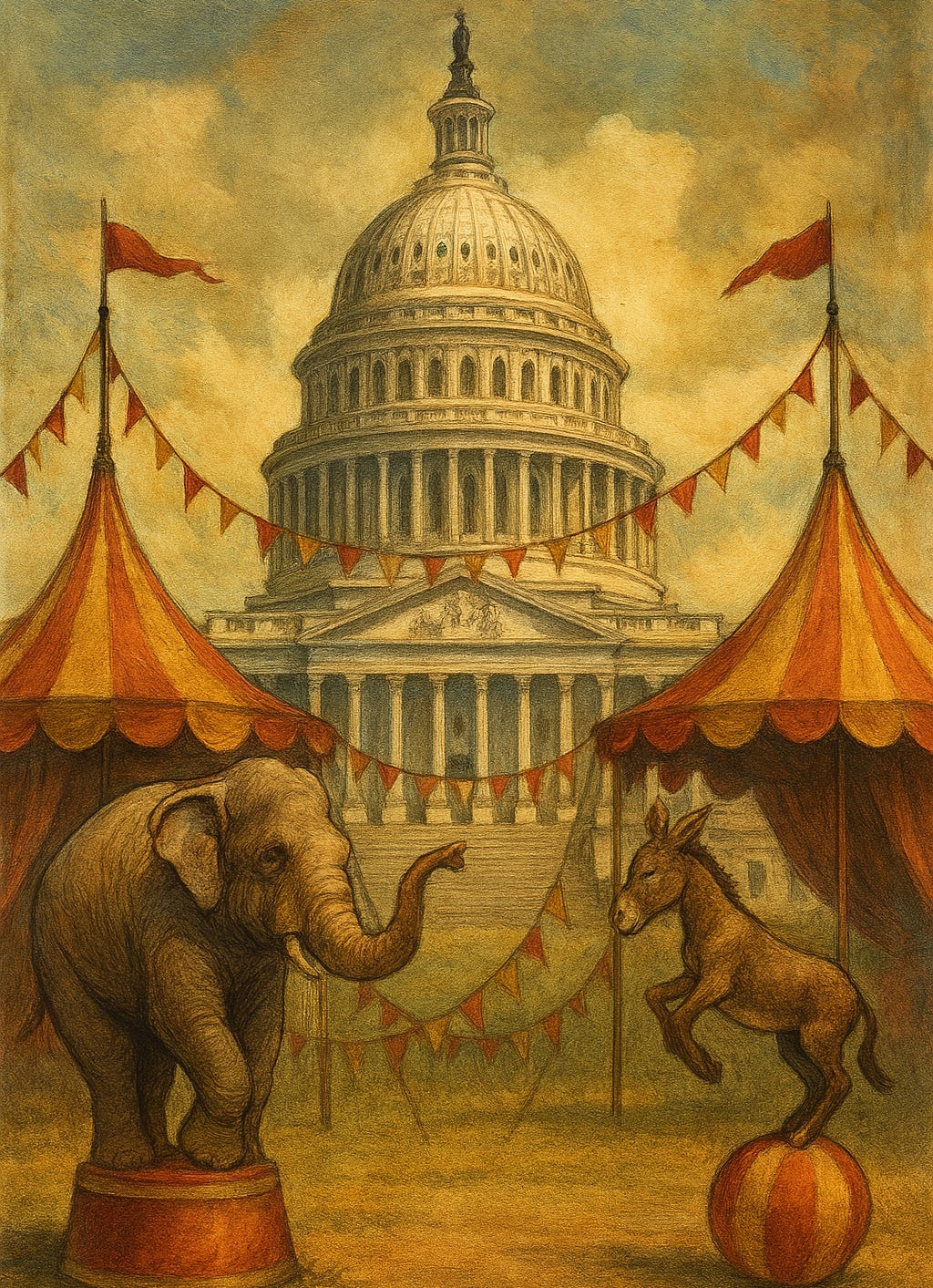
I woke late on October 1st, 2025. The news confirmed what the silence in the streets already suggested: the government had shut down. So I did what any systems-aware professional in D.C. might do: I called my favorite civil servant and asked him to brunch. He’d been out late the night before. No urgency. No inbox. Just the ambient stillness of a city paused by design.
This isn’t a timeout nor protest theater. The shutdown is a rupture in constitutional construction, a deliberate misfire that exposes the fault lines between governance and spectacle. Congress didn’t fail to act. It chose the shutdown game. And in that choice, it traded public service for partisan choreography.
We’ve seen this architecture before. The longest shutdown in U.S. history lasted 35 days under Trump in 2018–2019: five weeks of stalled governance, unpaid labor, and performative brinkmanship. Congress failed to pass a funding bill. The issue du jour: Democrats pushing to restore health care subsidies and reverse Medicaid cuts; Republicans refusing to negotiate. Politically, it was a safer battleground for Democrats, who, notably, made no move to curb the unconstitutional military presence deployed under the banner of immigration control. The contradiction was threaded, but unaddressed.
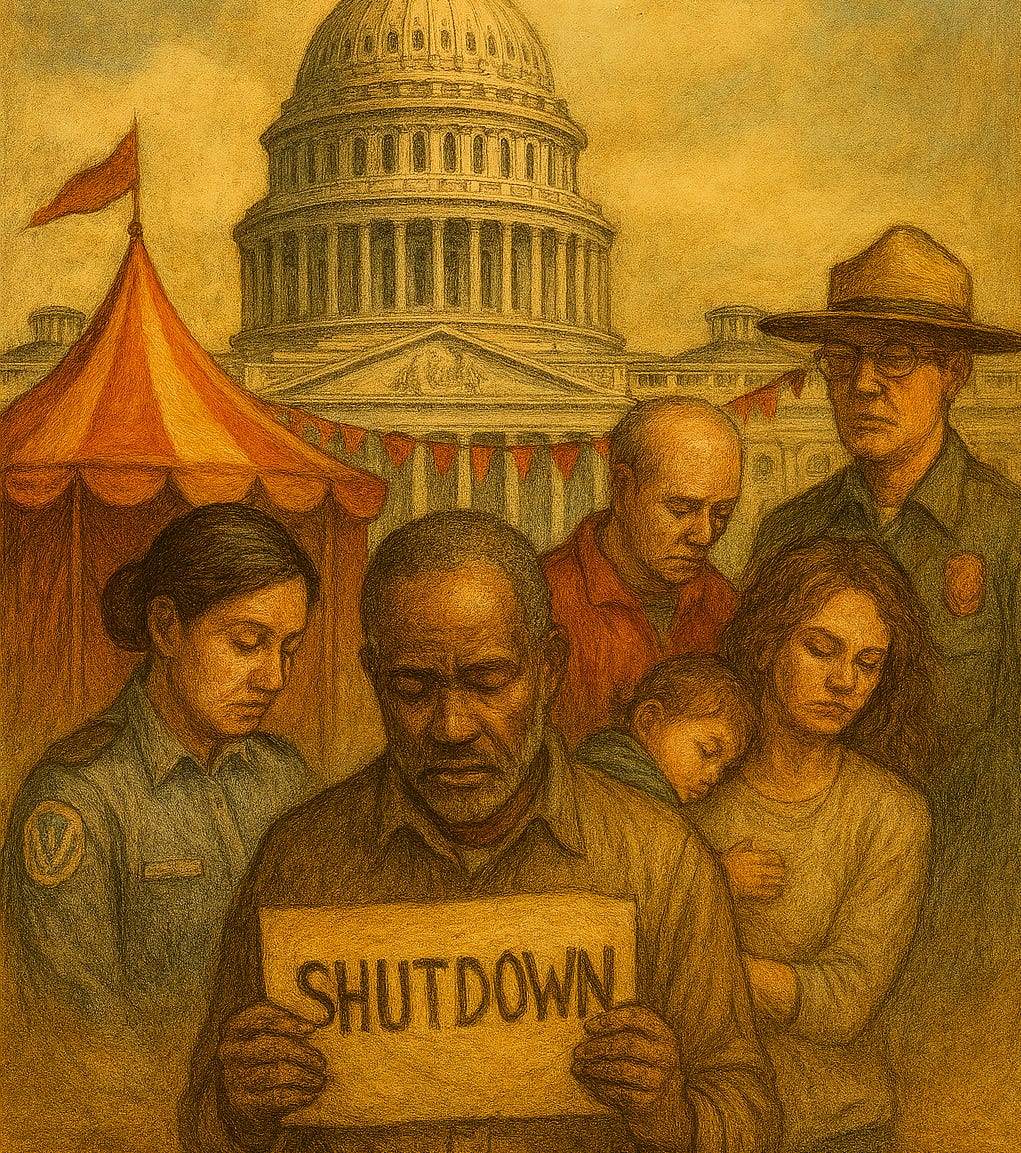
Shutdowns have become part of the playbook. Leverage tools. Messaging wars. But the consequences are not theoretical. They’re lived. Not just by my friend, but by millions (civil servants, contractors, families, people working in secondary markets in the DMV area, and so on) whose paychecks vanish while ideology postures. The system misfires, we, the people, absorb the blast.
What’s Different About This Shutdown
Unlike previous shutdowns; it’s a tactic. The Republican Party controls the House, Senate, and White House, and shows little urgency to reopen the government. The administration has already presided over deep spending cuts and service reductions; the shutdown simply accelerates its stated goal of shrinking federal infrastructure. Max Stier, president of the Partnership for Public Service, notes that past administrations sought to minimize harm. This time, the shutdown is being used to inflict it. There’s no clear exit strategy, only strategic rupture.
The rhetoric is more extreme, the incentives more fractured. Democrats are responding to a base that demands fewer concessions, while Republicans frame the impasse as resistance to “radical” demands. Healthcare subsidies remain the alleged sticking point. HUD’s homepage now displays partisan banners. Congressional leaders trade blame. And while polls show the public divided, the consequences are not: tens of thousands furloughed, laid off, or working unpaid. This isn’t gridlock. It’s a deliberate dismantling of governance.
What a Shutdown Is…and Is Not
It is not a complete shutdown. Essential services continue: military operations, air traffic control, Social Security, Medicare, and veterans’ benefits.
It is a halt to discretionary spending. That means furloughs for hundreds of thousands of federal workers; 750,000 by The Congressional Budget Office (CBO) estimates.
It is a delay in pay for those deemed “essential.” Yes, the military are government employees. Yes, they work without pay during shutdowns.
It is not within the president’s power to authorize payments. Only Congress can appropriate funds. Guaranteed payments are a legislative function, not an executive one.
And if you were planning to apply for a job with ICE to arrest U.S. citizens without probable cause or due process, you will also have to wait. And, if hired during the shutdown, get ready to work without pay and without the excuse of blaming immigrants.
Who Gets Hurt and How
The federal government shut down for the first time since 2019 on Wednesday morning. Essential operations continue: TSA agents, air traffic controllers, Social Security staff.
But the catch is brutal: many of these workers won’t see a paycheck until funding resumes. One missed check becomes two. And for families living paycheck to paycheck, that’s not a delay it’s a crisis.
Hundreds of thousands of federal employees are furloughed. They’re not working, but thanks to a 2019 law, they’re guaranteed back pay. Those still working (without compensation) are also covered by that law. But coverage doesn’t feed families in real time.
Members of Congress, of course, continue to be paid. So do postal workers, since USPS is a self-funded, independent agency. The optics are clear: those with the power to end the shutdown remain untouched by its consequences.
Federal contractors are hit hardest. Unlike federal employees, they don’t receive back pay. Their work stops. Their income vanishes.
Applicants to ICE and other agencies are told to wait; or work for free. Some are offered $50,000 bonuses to join, only to face hiring freezes and unpaid labor. The message is clear: apply now, serve later, get paid… eventually.
National parks remain open, but unstaffed. Trash piles up. Bathrooms lock. Ranger programs vanish. The CDC, NIH, and FDA lose large portions of their staff. Disease tracking slows. Drug approvals stall. Public health suffers.
What OPM Is Telling Civil Servants
The Office of Personnel Management (OPM) offers a fact sheet that reads like a survival manual for federal employees caught in shutdown crossfire. It outlines eligibility for Unemployment Compensation for Federal Employees (UCFE), a program administered by states but triggered by federal dysfunction. The irony is structural: civil servants must apply through state systems to recover wages withheld by the federal government.
Eligibility hinges on furlough status. Those officially furloughed may qualify for UCFE, but those deemed “essential” and forced to work without pay are excluded. The system rewards absence, not endurance. And even for those eligible, benefits vary by state, are subject to waiting periods, and often fall short of actual wages. OPM’s guidance is clear: apply, document, wait. But the subtext is louder: prepare to navigate a fragmented system built to delay relief.
The fact sheet reminds employees that back pay, if authorized by Congress, will retroactively cancel unemployment benefits received. In other words, if you survive the shutdown by claiming UCFE, you may be required to repay it once Congress decides you were always meant to be paid. The architecture is punitive, not protective. And it threads a deeper contradiction: the very system that demands loyalty from civil servants offers contingency, not compensation.
The Constitutional Fault Line
This isn’t just about programmatics. It’s about constitutional design. Shutdowns violate the logic of separation of powers. They weaponize budgetary control to stall governance. Democrats are concentrating on programmatic issues (this time healthcare coverage) and continue to ignore the constitutional threats the republic is facing (including military troops arresting American citizens without probable cause).
The one exception, U.S. Senator Chris Murphy, said it plainly: Democrats have no obligation to fund unconstitutional behavior. That includes surveillance without probable cause, ICE raids without oversight, and executive overreach that mirrors the very regimes we once criticized.
The shutdown exposes a deeper truth: there is no federal law addressing domestic terrorism (nor an organized terrorist campaign in domestic soil for that matter). No coherent framework for managing radical threats (from neither far-right nor far-left individuals). And yet, agencies are asked to operate without pay, without clarity, and without constitutional guardrails.
The Political Theater
The House majority is razor-thin. Speaker Johnson faces tight margins to move a continuing resolution (CR).
Bipartisanship is not optional. It’s the only solution. Without it, the Titanic hits ice, again.
Kentucky senators call for “no insane spending,” while others push discharge petitions to force action on unrelated issues, like Epstein files. The shutdown becomes a proxy war for everything else.
Shutdown logic is now part of the playbook; a failure turned tactic. But the tactic fractures the system.
The Real Cost: Unserious Behavior, Serious Consequences
CBO estimated that the last government shutdown reduced U.S. economic output by $11 billion over two quarters, $3 billion of which was never recovered. That’s not delay, it’s losses reflected on P&Ls across businesses.
In the current shutdown, CBO projects that roughly 750,000 federal employees could be furloughed each day. Their combined compensation (approximately $400 million daily) represents not just withheld pay, but economic drag. Every day the system misfires, the economy bleeds.
Congress has traditionally voted to retroactively pay federal workers, both those furloughed and those forced to work unpaid, once a deal is reached. But tradition is not protection. And back pay doesn’t feed families in real time.
63% of Americans live paycheck to paycheck. One missed check is not a delay, it’s a collapse. Families don’t eat ideology. They eat food. And when paychecks stop, pain begins.
Lawsuits are already underway. The American Federation of Federal Employees is challenging the shutdown’s legality. Trump’s budget chief, Russ Vought, has floated plans to fire federal workers during the shutdown, a move that may violate federal law.
This is not just a budget fight. It’s a constitutional reckoning.
Shutdowns are systemic failures. They expose unserious behavior in serious times. They fracture the architecture of governance and leave real people (civil servants, contractors, families) without pay, without clarity, and without recourse. And the system cannot afford another.
Like this piece?
If this piece holds, consider sustaining the signal: subscribe, pledge, buy me a cup of coffee, or fund the next dispatch however you see fit. Every act of support helps metabolize the noise and keep the infrastructure unfinished but alive. Repost if it threads utility. Share if it exposes contradiction. Let it circulate where it’s needed most.
References
Congressional Budget Office. (2025). Effects of the government shutdown. https://www.cbo.gov/system/files/2025-09/61773-Government-Shutdown.pdf
Joint Economic Committee Democrats. (2025). The economic cost of the government shutdown. https://www.jec.senate.gov/public/index.cfm/democrats/issue-briefs?id=B7FCE9F4-4DFE-495C-8263-AD277CE4716B
Congress.gov. (2019). S.24 - Government Employee Fair Treatment Act of 2019. https://www.congress.gov/bill/116th-congress/senate-bill/24
Fast Company. (2025). Why this government shutdown is different. https://www.fastcompany.com/91414276/why-this-government-shutdown-is-different
Murphy, C. (2025). Murphy, bicameral group of Democrats announce plans to introduce legislation to protect free speech, safeguard against politically motivated harassment and prosecutions. https://www.murphy.senate.gov/newsroom/press-releases/murphy-bicameral-group-of-democrats-announce-plans-to-introduce-legislation-to-protect-free-speech-safeguard-against-politically-motivated-harassment-and-prosecutions
Investopedia. (2025). Living paycheck to paycheck: Why it’s now a luxury for many Americans. https://www.investopedia.com/living-paycheck-to-paycheck-why-it-s-now-a-luxury-for-many-americans-11763236
Social Security Administration. (2025). SSA contingency plan for government shutdown. https://www.ssa.gov/agency/shutdown/materials/contingency-plan-09-24-25.pdf
U.S. Department of Transportation. (2025). DOT shutdown plan. https://www.transportation.gov/sites/dot.gov/files/2025-09/DOT_Shutdown_Plan_9.30.25.pdf
Committee for a Responsible Federal Budget. (2025). Government shutdowns Q&A: Everything you should know. https://www.crfb.org/papers/government-shutdowns-qa-everything-you-should-know
White House Archives. (2013). Impacts and costs of the government shutdown. https://obamawhitehouse.archives.gov/blog/2013/11/07/impacts-and-costs-government-shutdown
Congressional Research Service. (2025). R47751 - Federal government shutdowns: Causes, processes, and effects. https://www.congress.gov/crs-product/R47751
Stier, M. [Max]. (n.d.). LinkedIn profile. LinkedIn. https://www.linkedin.com/in/max-stier/
U.S. Office of Personnel Management. (2025). Furlough guidance. https://www.opm.gov/policy-data-oversight/pay-leave/furlough-guidance/
Excellent analysis of a complicated situation. It's so difficult to not take sides when there are so many accusations circulating. This line stood out to me because it seems to be so true, "The optics are clear: those with the power to end the shutdown remain untouched by its consequences."
The people are being negatively affected and the system and its safeguards to protect us are prevented from functioning. The importance of having three interdependent branches of government becomes painfully clear with the current cost of the shutdown affecting real life situations because the system has broken down through manipulation.
Wow… thank you for breaking this down so clearly. The details about who actually bears the burden during a shutdown are staggering. It’s a sharp reminder that these political games have real, human consequences, not just headlines.✨