
When The Sign Comes Down
What middle powers coordination looks like when subordination becomes more expensive than resistance

Disclaimer: This assessment is for informational purposes only and is non-partisan. All things in life are neutral until you put perspective. My goal is to address the facts and apply scrutiny through curiosity. Any statements that could be interpreted as opinion do not reflect the views of any past, current, or future employers. I encourage you to do your own due diligence (References are at the bottom of the essay), utilize critical thinking, and form your own opinion. My intent is not to pontificate or prescribe anything, but I do make a call to action to think or rethink. This is not a bill. It’s not a legislative analysis. It’s an brief built for reflection. If it stings, it’s probably because the truth hurts. That’s enough reason to get through the end.
Miguel de Unamuno stood in the University of Salamanca in 1936 and told the fascists something they already knew but couldn’t admit before the Caudillo:
Venceréis, pero no convenceréis.
You will win, but you will not convince.
Unamuno identified the structural limitation of force. Violence can silence. Military intimidation can occupy space. But neither can persuade. Let alone inhabit truth. Brute force helps you win. It doesn’t make you right. It doesn’t change what people know to be true. It just makes them stop saying it out loud.
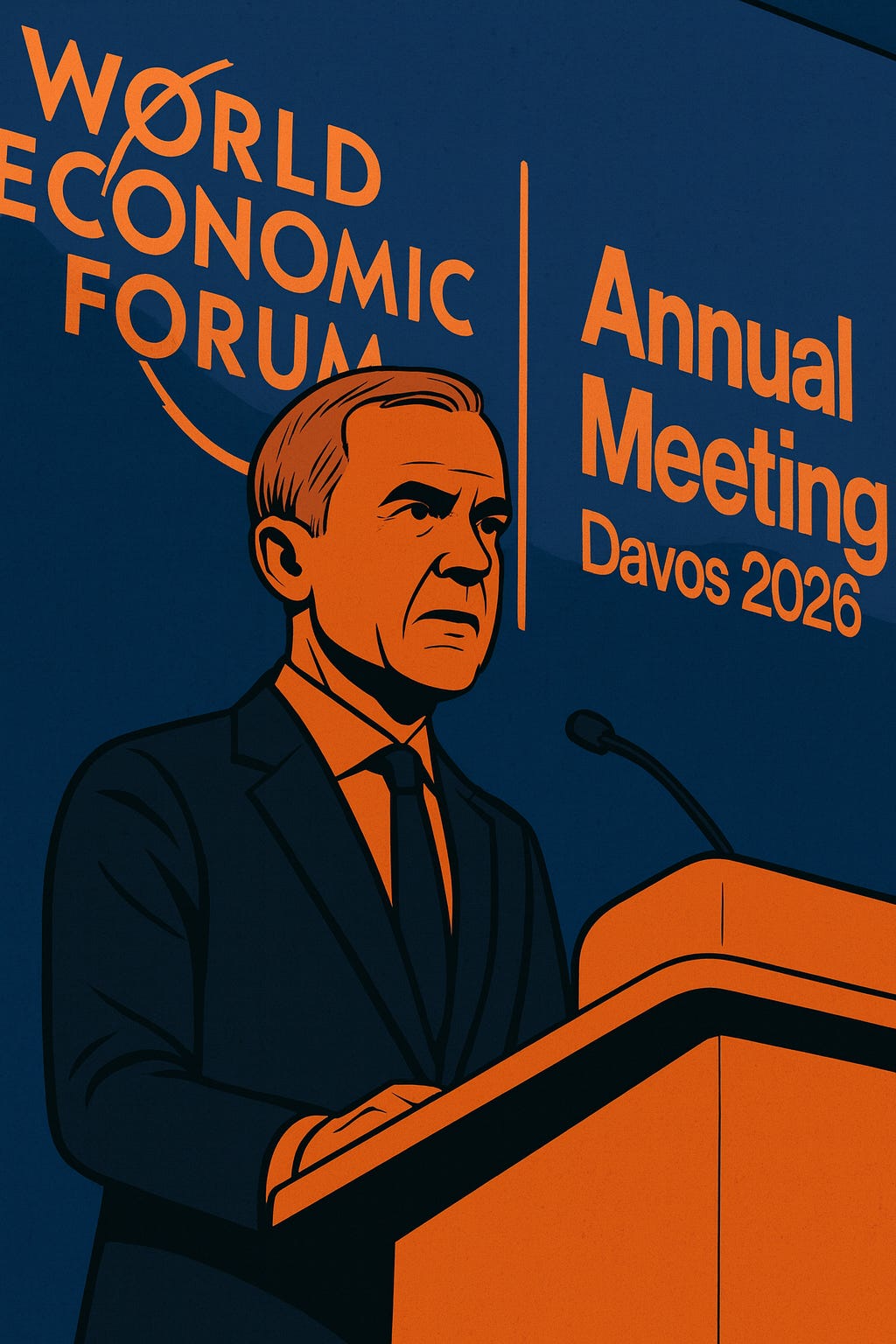
On January 20, 2026, Mark Carney stood in Davos and drew the same line. Not about fascism. About the fiction middle powers keep performing. The rules-based international order they invoke no longer exists and all that is left is theater. A performance of sovereignty while accepting subordination. He stated that middle powers need to stop participating in the ritual.
He opened with a Czech dissident’s observation about how systems sustain themselves through collective pretense. Václav Havel wrote about a greengrocer, living under a communist regime, who placed a sign in his window every morning:
“Workers of the world unite. The shopkeeper didn’t believe it. No one did. But he displayed the sign anyway.”
To avoid trouble. To signal compliance. To get along. And because every shopkeeper on every street did the same, the system persisted not through violence alone, but through participation in rituals everyone privately knew to be false.
Havel called this living within a lie. The system’s power came not from truth but from everyone’s willingness to perform as if it were true. Its fragility came from the same source. When even one person stops performing, when the greengrocer removes his sign, the illusion begins to crack.
Carney’s proposition: it is time for companies and countries to take their signs down.
The Lie of Mutual Benefit
For decades, countries like Canada prospered under what they called the rules-based international order. They joined its institutions. Praised its principles. Benefited from its predictability. They knew the story was partially false. The strongest would exempt themselves when convenient. Trade rules were enforced asymmetrically. International law applied with varied rigor depending on who was accused, who was victim. But this fiction was useful. American hegemony helped provide public goods. Open sea lanes. Stable financial system. Collective security. Frameworks for resolving disputes. So they placed the sign in the window. Participated in the rituals. Largely avoided calling out the gaps between rhetoric and reality. But this bargain no longer works.
Carney was direct. He said that we are in the midst of a rupture, not a transition. Great powers have begun using economic integration as weapons. Tariffs as leverage. Financial infrastructure as coercion. Supply chains as vulnerabilities to be exploited. And added that countries cannot live within the lie of mutual benefit through integration when integration becomes the source of your subordination.
Many countries are drawing the same conclusion: they must develop greater strategic autonomy. In energy. In food. In critical minerals. In finance. In supply chains. A country that cannot feed itself, fuel itself, or defend itself has few options. The multilateral institutions on which middle powers relied, the WTO, the UN, the COP, the very architecture of collective problem solving, are under threat. When the rules no longer protect you, you must protect yourself.
The cost of strategic autonomy can be shared. Collective investments in resilience are cheaper than everyone building fortresses alone. The question for middle powers isn’t whether to adapt -they must- but rather whether they adapt by building higher walls or whether they can do something more ambitious.
His answer: variable geometry. Different coalitions for different issues based on common values and interests to replace naive multilateralism relying on broken institutions. Creating a dense web of connections across trade, investment, and culture that can be drawn on for future challenges. In other words, middle powers must act together because if they’re not at the table, they’re on the menu.
Great powers can afford to go it alone. They have market size. Military capacity. Leverage to dictate terms. Middle powers do not, and when they only negotiate bilaterally with a hegemon, they negotiate from weakness. Accept what’s offered. Compete with each other to be most accommodating. Performance of sovereignty while accepting subordination.
Then Carney named what living the truth means. Stop invoking rules-based international order as though it still functions. Call it what it is: intensifying great power rivalry where the most powerful pursue interests using economic integration as coercion. Act consistently. Apply same standards to allies and rivals. When middle powers criticize economic intimidation from one direction but stay silent when it comes from another, they are keeping the sign in the window.
Build what you claim to believe in rather than waiting for the old order to be restored. Create institutions and agreements that function as described. Reduce the leverage that enables coercion. Build strong domestic economies and diversify internationally, because countries earn the right to principled stands by reducing vulnerability to retaliation.
Canada is taking the sign out of the window.
Carney did not hold back and said clearly that “the old order is not coming back. Nostalgia is not a strategy. But from the fracture we can build something bigger, better, stronger, more just.” This is the task of middle powers. Countries with most to lose from a world of fortresses and most to gain from genuine cooperation. The powerful have their power. But middle powers have something too: capacity to stop pretending, name realities, build strength at home, and act together.
That was Tuesday. By Wednesday morning, the European Parliament showed what taking the sign down looks like.
Trump threatened 10 to 25 percent tariffs on eight European nations over Greenland. Within 24 hours of Carney’s speech, the European Parliament suspended work on the EU-US trade agreement. This was a direct response. Bernd Lange, chairman of the European Parliament’s international trade committee, stated their sovereignty and territorial integrity are at stake. Business as usual is impossible.
Right about now, some of your reading may be thinking, “You must not understand the current administration’s foreign policy approach. Trump always comes out guns blazing and settles down for less at the negotiating table.” But while your observation is accurate, this time is different. They suspended participation in the trade ritual when sovereignty was directly threatened. Then announced they would discuss the EU’s Anti-Coercion Instrument. A measure that would substantially restrict US companies’ access to the single market. Block them from tenders. Reduce flow of goods and capital. Curb foreign direct investment.
This is the leverage Carney described. The EU bloc, 450 million people, 18 trillion dollars in GDP, threatening to restrict US corporate access. That’s coordinated strength. A rapid response to direct coercion.
Trump backed off. Within hours announced a framework agreement with NATO Secretary General Mark Rutte on Greenland. The framework involves mineral rights for the US and European allies and collaboration on Golden Dome missile defense. Not full Greenland ownership. The middle power coalition extracted concessions from the hegemon.
The political consensus behind this matters. Conservatives, socialists, liberals, greens agreed to scrap the vote. When conservative EPP aligns with left-wing parties on coordinated response to US coercion, that’s not fragile coalition. That’s broad consensus that sovereignty threats override partisan divisions.
And the financial diversification Carney described is already happening. European pension funds in Denmark and Sweden exiting US Treasuries in response to Trump’s Greenland threats.
Canada explicitly aligned. Stand firmly with Greenland and Denmark. Fully support their unique right to determine Greenland’s future. Strongly oppose tariffs over Greenland.
The EU just demonstrated the cost calculation shifted. Accepting subordination became more expensive than coordinating refusal.
What A New Order Actually Builds
If middle powers sustain this, you’re looking at fundamental restructuring.
Start with trade. Currently great powers sit at hub-and-spoke centers. US anchors USMCA and bilateral Pacific deals. China anchors RCEP and Belt-and-Road. Everyone else connects bilaterally, competing for favorable terms.
Carney proposed building a bridge between Trans-Pacific partnership and European Union. Trading bloc of 1.5 billion people. Forming buyer’s clubs to diversify away from concentrated supply. If that happens, you create a third pole. Coordinated market of 1.5 billion consumers. Companies can’t ignore it. That bloc sets standards. It requires labor practices. Demands technology transfer. Coordinates procurement for leverage. Build to these specifications or you’re locked out.
Companies face three major configurations instead of two. US market, 330 million high-income. China market, 1.4 billion mixed-income. Middle power bloc, 1.5 billion high-income. Building three parallel supply chains fragments global production but prevents any single great power from weaponizing market access unilaterally.
Right now, when US threatens tariffs, individual countries scramble bilaterally for exemptions. Each undercuts the other. In middle power order, Canada doesn’t negotiate alone. Entire bloc responds collectively. Tariff us, lose access to 1.5 billion consumers simultaneously. Changes the cost calculation.
Defense follows same logic. Most middle powers depend on American weapons. Logistics. Intelligence. Structural dependence. If US threatens to withhold support, you comply. Canada joined SAFE European Defence Procurement. Doubling defense spending by decade’s end in ways that build domestic industries. Working with Nordic-Baltic Eight on unprecedented investments in over-the-horizon radar. Submarines. Aircraft.
When Canada, EU, Japan, South Korea, Australia align on defense standards and commit to buying from each other, they create viable ecosystems outside US control. You need scale for defense production viability. Canadian fighter program alone can’t sustain R&D costs. But Canada plus EU plus Japan plus Korea plus Australia creates sufficient volume. Development costs amortize across production runs big enough to work.
EU already proved this. Airbus exists because France and Germany coordinated. Extend that to Canada, Japan, Korea and you’ve built parallel capacity not depending on Washington’s approval. Doesn’t make middle powers peer competitors militarily. But makes them non-vulnerable to coercion through security withdrawal.
Financial architecture transforms. Currently dollar dominance. Most trade settles in dollars. Most reserves held in dollars. Most debt denominated in dollars. US weaponizes through sanctions. SWIFT exclusion. Secondary sanctions threatening dollar access.
Middle powers build parallel infrastructure not routing through New York. Cross-border central bank digital currencies for trade settlement. Coordinated reserve diversification. Alternative payment rails bypassing SWIFT. Regional development banks not requiring IMF or World Bank approval.
Canada’s pension funds are among the world’s largest and most sophisticated investors. Canadian, European, Japanese, Korean, Australian pension funds coordinating represent over 20 trillion dollars. Sufficient to finance trade between members without dollar intermediation. Fund infrastructure in developing nations creating alternative poles. Provide liquidity for payment systems settling in euros. Yen. Canadian dollars. Won.
The dollar doesn’t collapse, but monopoly erodes. Instead of 88 percent of trade settling in dollars, drops to 60 percent. Instead of 60 percent reserves in dollars, drops to 45 percent. US still benefits from reserve currency status but exorbitant privilege shrinks. More importantly, US loses ability to unilaterally sanction through dollar exclusion. If Canada-EU-Japan-Korea-Australia trade settles through alternative rails, US financial sanctions become less effective.
Technology standards become contested. Currently US and China develop parallel stacks. 5G is Huawei or Qualcomm. Cloud is AWS, Azure, Google or Alibaba, Tencent. AI training on Nvidia chips or Chinese alternatives. Everyone picks which ecosystem to join.
Carney proposed on AI, Canada cooperates with like-minded democracies to ensure they won’t be forced to choose between hegemons and hyperscalers. EU already proved the model with GDPR. It set regulatory standards backed by market access to 450 million people. US companies built GDPR-compliant systems because losing EU market access was too expensive.
Extend to Canada-EU-Japan-Korea-Australia, combined 1 billion people mostly high-income, and you create regulatory power over AI governance. Data sovereignty. Encryption standards. Satellite licensing. Spectrum allocation. Companies developing AI need training data at scale. If middle power bloc requires data localization and algorithmic transparency for market access, companies build to those specifications. Not because middle powers have superior AI. Because 1 billion high-income consumers represents too much revenue to abandon.
Currently tech companies optimize for US or Chinese regulatory environment. Treat everyone else as secondary markets that adapt. In middle power order, there’s third major regulatory pole. Creates costly fragmentation and no single great power imposes standards unilaterally.
The Variable Geometry in Practice
Diplomacy operates through what Carney called variable geometry. Different coalitions for different issues. Instead of expecting UN Security Council to function, which it won’t because great powers veto anything constraining them, middle powers form issue-specific coalitions.
On climate, EU-Canada-Japan-Korea-Australia-Pacific Islands coordinate carbon border adjustments. Technology standards. Development finance for renewables. Represent enough global GDP that their carbon pricing becomes de facto standard.
On Ukraine, Coalition of the Willing coordinates military aid. Sanctions enforcement. Reconstruction finance. Russia faces unified opposition without requiring UN authorization.
On critical minerals, buyer’s club coordinates procurement breaking Chinese processing monopoly. Pools resources for mine development. Sets environmental and labor standards for market access.
On digital governance, democratic nations coordinate on data flows. Encryption standards. Content moderation. Create interoperable regulatory environment companies can build for.
Each coalition has different membership based on aligned interests. Some countries participate in all. Canada. Core EU states. Some selectively. India might join critical minerals coalition but not Ukraine coalition. Network density creates relationships leverageable across issue areas.
When middle powers want collective action, they bypass paralyzed multilateral institutions. Build functional coalitions excluding obstructionist great powers.
The Cost Of It All
Canada fast-tracking one trillion dollars in investments while doubling defense spending by decade’s end. What middle powers pay for: defense capacity costing more than US imports. Redundant supply chains less efficient than single-source. Financial infrastructure duplicating dollar-based systems. Technology development that could be outsourced. Diplomatic capacity maintaining multiple coalitions.
Currently middle powers free-ride on US security. Use efficient global supply chains. Access US financial infrastructure at minimal cost. Adopt US or Chinese technology standards. In middle power order, they pay a premium for strategic autonomy. Maybe 2 to 3 percent more GDP in defense spending. Higher costs for domestic goods. Lower returns on diversified reserves. Fragmented technology ecosystems less efficient.
Can democracies sustain this over multiple election cycles when voters see higher costs but benefits, avoiding subordination, are abstract and long-term? Only works if threat perception remains high enough, enough middle powers commit that critical mass creates leverage, coordination succeeds enough that visible wins justify investment, great powers overreach sufficiently that publics support the premium.
Looking Through the Stability Glass
Network effects favor stability. As more join, membership value increases. First movers pay highest costs. Later joiners benefit from existing infrastructure. Countries successfully reducing great power leverage demonstrate model works. Variable geometry lets countries participate where interests align. As middle powers trade more with each other, exit costs increase.
But collective action problems favor collapse. Any individual middle power benefits from defecting for bilateral deal while others coordinate. Democracies struggle maintaining expensive strategic investments when benefits are long-term and diffuse. US or China could target individuals with punishment fragmenting coalition. Government changes in Canada, Germany, Japan could abandon coordination for accommodation. Acute crisis might trigger bilateral reversion for immediate relief.
Historical precedent says this is fragile. Non-Aligned Movement failed. Most trade bloc stay regional. Defense cooperation remains within great power frameworks. Pull toward bilateral deals with hegemons is strong. Benefits immediate and concentrated. Coordination costs diffuse and long-term.
Current moment differs. Great power overreach is visible and sustained. Trump threatening Greenland gave middle powers concrete vulnerability example. China’s economic coercion against Australia, Lithuania demonstrates threat is bipartisan and structural. When threat is abstract, coordination fails. When concrete and repeated, coordination becomes politically viable.
The Greenland episode made the threat concrete. Trump made coordination politically viable by demonstrating exactly what Carney warned about. The question is whether middle powers remember this when the threat becomes abstract again.
The world order that emerges won’t be what Carney outlined in full. It will be messier. More variable. Less predictable. But it won’t be pure great power domination with middle powers as subordinate participants either. Something shifted. Greenland proved that. The fiction that the old order still functions ended in Davos Tuesday. By Wednesday the EU showed what comes next when middle powers decide the performance is over.
The sign came down. We’ll see how many others follow. How long they can keep it down. What they build in its place. But the moment of pretending passed. What comes next depends on whether middle powers can sustain the courage to live outside the lie when great powers make living inside it more comfortable again. That’s the test: whether they’ll keep using the model when it gets expensive.
Unamuno told fascists they could win but not convince. Carney told middle powers they could perform sovereignty or build it. The EU chose to build. Trump didn’t back off because he was convinced middle power coordination is right, but because forcing compliance became more expensive than accepting compromise. That’s structural leverage. The sign came down. Whether it stays down depends on whether middle powers can sustain the cost when great powers offer to make compliance cheaper again.
Like what you see here?
If this piece holds, consider sustaining the signal: subscribe, pledge, buy me a cup of coffee, or fund the next dispatch however you see fit. Every act of support helps metabolize the noise and keep the infrastructure unfinished but alive. Repost if it threads utility. Share if it exposes contradiction. Let it circulate where it’s needed most.
Stay sane. Stay sharp.
References
Carney, M. (2026, January 20). Full speech script: Mark Carney at the World Economic Forum Annual Meeting 2026. Global News. https://globalnews.ca/news/11620877/carney-davos-wef-speech-transcript/
DW News. (2026). Trump–Greenland agreement: A deal everyone is happy with [Live update]. Deutsche Welle. https://www.dw.com/en/trump-greenland-agreement-a-deal-everyone-is-happy-with/live-75588065
BBC News. (2026). [Article title unavailable]. BBC. https://www.bbc.co.uk/news/articles/c4gwp2me3gzo
(If you want, I can retrieve the article title once you paste it.)
Euronews. (2026, January 21). Trump suspends European tariffs after framework Greenland deal agreed. https://www.euronews.com/2026/01/21/trump-suspends-european-tariffs-after-framework-greenland-deal-agreed
Carney, M. (2026, January 20). Special address by Mark Carney, Prime Minister of Canada – World Economic Forum Annual Meeting 2026 [Video]. YouTube.
Edwin, you caught my attention this morning!
it would be a beautiful thing if Trump accidentally created a more equitable world economy with his idiot stunts. In the meantime, we are in for more of a bumpy ride.
Great piece, as always.