

Foreword: The Physics of a Third Death is a story about a girl named Daniela, a boy named Iker, and a town that was promised a future it could never afford. It is also a story about extraction, corporate ambition, and the way small places become footnotes in someone else’s economic miracle. But at its core, it is about the strange and fragile ways we survive the impossible. Stories like this are are meant to be inhabited.
Welcome to The Physics of a Third Death.
Let’s step inside.
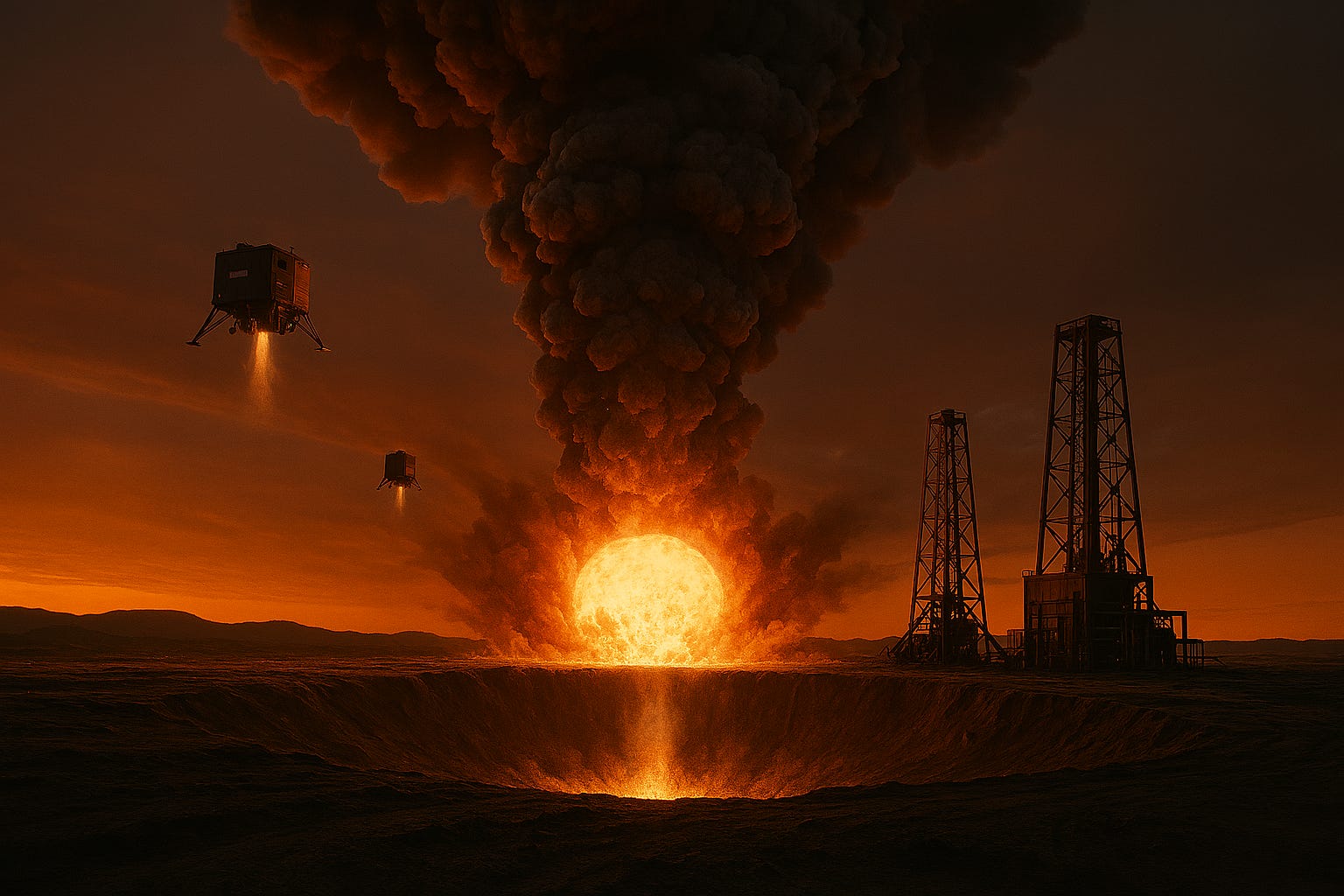
Prologue: They Own The Moon
The year 2024 began with a kind of restless optimism, the sort that makes people believe the future is finally ready to behave. Three robot operated vessels, one from India, one from Russia, and one from Japan, left Earth with a single purpose. They were sent to reclaim the moon as a frontier of extraction. The age of wonder was over. No more small step for a man and giant leap for mankind. This was a mining contract with better lighting.
The world had grown hungry for the rare minerals that powered every device, every network, every quiet miracle of modern life. The moon became a quarry. A very expensive one, but a quarry all the same.
In 2025 the first vessel from Japan touched down on the lunar surface. The landing was streamed everywhere. Children watched it in classrooms. Investors watched it on their phones. Politicians watched it with the same expression they used for AI legislation, which is to say they pretended to understand what was happening. Something enormous had begun.
Within months the Japanese vessel discovered exploitable ice deposits on the dark side of the moon. Enough to change everything. Water meant fuel. Water meant processing. Water meant the moon could sustain operations that would have been impossible otherwise. The discovery turned a promising venture into an economic revolution.
The moon was a treasure chest of rare earths, iron, lithium, titanium, and helium 3, the isotope that powered nuclear fusion for thousands of years. Once scientists figured out how to use hydrogen as a second combustible, the entire equation changed. Energy became cheap. Transport became simple. The moon was no longer a distant rock in the sky. It was the most valuable piece of real estate in human history.
By 2026 multinational corporations had carved the moon into zones of ownership. One company rose above the rest, F9 Global, short for Femtometre Global Limited. But it did not matter what its official name was. People simply called it The Company. It controlled the water extraction rights. It controlled the shipping lanes, and the politicians in every country where they operated. It controlled the future. The Company moved fast. The world moved faster. International agreements were rewritten in months. Space treaties that had taken decades to negotiate were amended under pressure from governments and investors who did not want to be left behind. No one owns the moon became a thing of the past.
Construction began across small towns worldwide. Places where land was cheap and people were grateful for any promise of work. The United States included. By 2028 processing plants were operational. Mined metals were used to build structures in space that were too difficult and too expensive to construct on Earth. Getting materials from the moon became an asteroid mining operation with training wheels. Lower gravity meant easier transport. Massive quantities of raw materials. Huge components built on the moon and shipped out like cosmic freight.
The transformation was immediate. New federal and local legislation for expansion. New roads. New plants and factories. New money. New hope.
And then came Amarillo.
Amarillo, Texas had been struggling for years. Drought. Job losses. A shrinking tax base. The kind of slow decline that makes a town vulnerable to promises. When The Company arrived with contracts and smiles and a plan to build a processing plant, the town council barely hesitated. The Company wanted water rights. The Company wanted electricity rights. Amarillo needed money, jobs, a future. The lobbying was relentless. The deal was signed.
By 2028 the plant was online. By 2030 production targets had doubled. Water usage exceeded anything the region could sustain. The warnings were there. The engineers knew. The maintenance crews knew. The town knew. But The Company had already bought the rights, and with it the silence. There was never enough water, but the land was much too cheap to be left alone.
And then, on August twenty fifth, 2031, the explosion.
It tore through the plant like a second sun. Radiation spread through the air and soil. Entire families vanished in a single night. The world watched the news in stunned silence. Reporters called it the worst national tragedy since Tri Cities Washington. Scientists compared it to nothing at all.
In that little town a girl named Daniela lost her best friend. His name was Iker. They had grown up together. They had shared classrooms and summers and secrets. When the list of the dead was released, her parents held her as she cried. The funerals came and went. Most bodies were buried in mass graves. Most bodies were never identified. The assumption was simple. The blast had killed everyone, either instantly or shortly after from the radiation. The town tried to rebuild itself around the crater of its own grief.
Then came the miracle.
Like What You See?
I am releasing this novel slowly. Paid subscribers will receive every chapter as it is released, along with notes, sketches, and the architectural scaffolding behind the story. Think of it as stepping behind the curtain to see how the system is built. But the Prologue belongs to everyone.
If the Prologue resonates with you, if you feel the pull of the mystery or the weight of the world behind it, I invite you to join me as a paid subscriber. Not just to read the chapters, but to be part of the unfolding.

Really cool.
Edwin, this prologue is incredibly immersive. I love how you’ve woven the futuristic corporate world, lunar exploration, and human fragility together. The way you show small towns like Amarillo caught in the machinery of ambition makes the story feel both vast and deeply personal. I’m already intrigued to see how Daniela and Iker navigate this fragile, impossible world.